Observation
Within seconds, most people can identify if a home was comprehensively designed by an architect. What is less obvious is, why?
Question
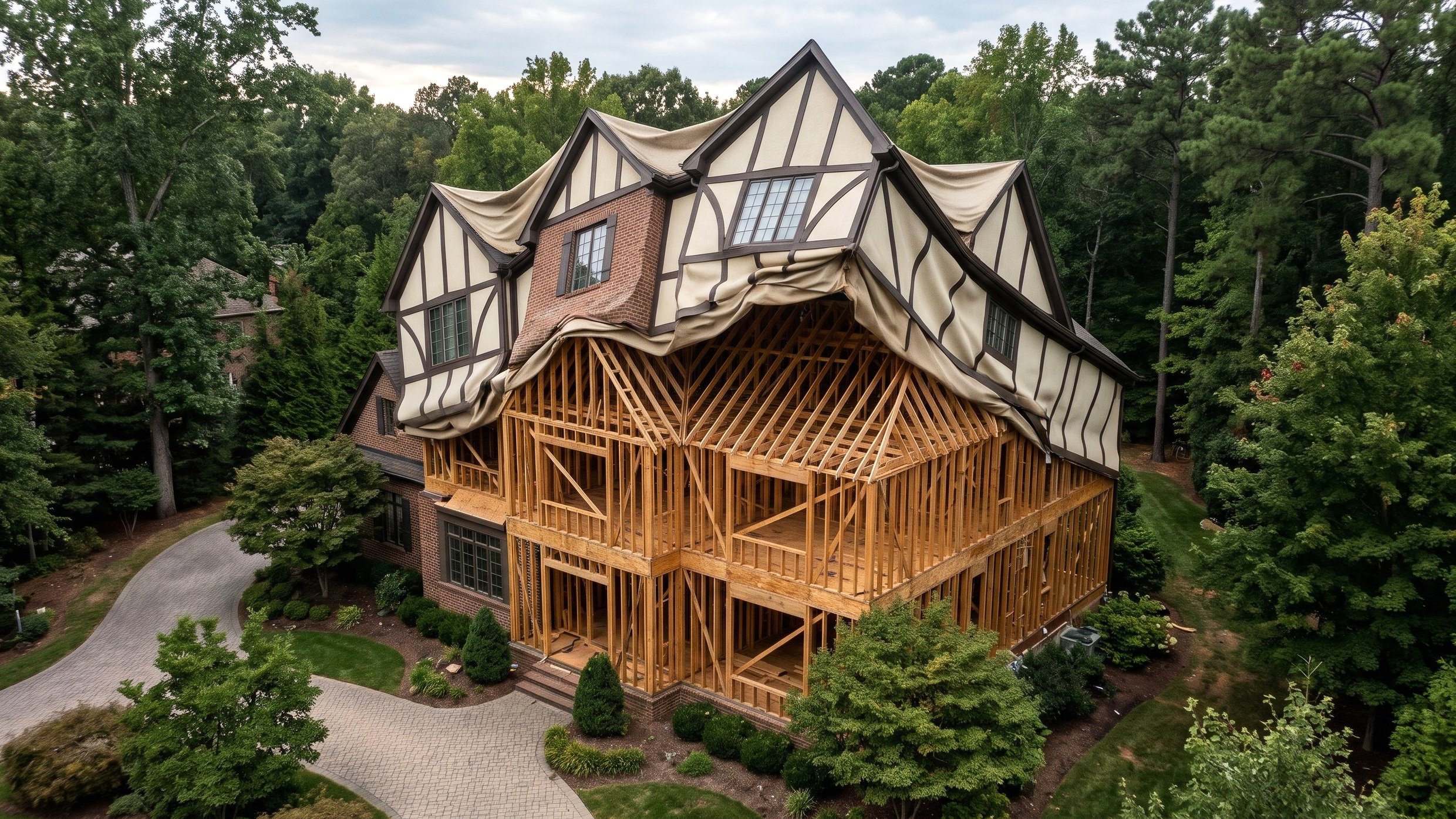
What makes a home feel thoroughly considered, contributing to its rich and holistic character? Homebuilding, like many other crafts, has been infiltrated by the economics of large scale manufacturing, resulting in architecture that in many cases feels like an applied aesthetic, rather than an integral process or methodology. In other words, architectural style has been reduced to a catalog selection of windows, doors, and cladding that is applied as a skin or facade on a generic stick-built structure. Even structural components such as roof trusses or engineered floor joists are now manufactured at scale resulting in projects that can feel more like an amusement park stage setting rather than an authentic architectural design assembled thoughtfully with stylistic integrity. So then, what exactly is the defining element between a home with applied style versus a home that is thoroughly considered? Can a home still feel truly custom when it is composed of so many stylised manufactured components? Thankfully, the answer to that question is, ‘Yes’ however more importantly is the reason how, and why?
Exploration
In order to understand the how and why, let’s first define the responsibilities of an architect. An architect provides more than applied experience and proven layouts. The practice of architecture is rooted in systems-thinking, a process that methodically interweaves all aspects of a project resulting in a built form that represents the project’s complete storyline.
This includes everything from site planning and interior layouts, to exterior elevations and material selections; but also, managing client relationships, project budget, timeline and many more nonmaterial aspects of a project required to bring a structure to life. The final built form carries this process in every stud erected, every shingle laid, but more importantly in the embedded thought carried from the first architectural sketch, into the concrete footings, through the gridded french windows and into the reassured mind of the homeowner as they sip their freshly brewed morning coffee.
So how does this process provide integrity, and how does that integrity translate into the feeling that a home was designed and considered more holistically compared to a home with an applied aesthetic. Simply put, it is the attention to detail; the consistency of materials; the cultural accuracy, honesty, and homage paid to the origin of the architectural style; the function, the lifestyle, the meaning, the purpose. These elements are all easily dismissable from the lens of a homebuilder looking only to capitalize on a trending aesthetic, or transient social norms. The issue with dismissing these deeply rooted elements of design is that a home then relies solely on a generic framework, configured with a ubiquitous floor plan, capable of wearing many skins, but without any substance or weight to ground the architecture to the site in any meaningful way. The “architecture” is then independent from the site, from the structure, from the experience the home offers its dwellers; and a home built in this fashion rarely outlives the generation it was built by. No longevity, no invested spirit, no generationally shared experiences, values, or wealth.
An architect understands how to embed these characteristics, carefully and thoughtfully while respecting and honoring the architectural style of a home and its inhabitants who dreamt of its permanence. An architect works rigorously and diligently to align seemingly disparate elements of a project; marrying materials with functionality, embedding lifestyle routines within a floor plan, and negotiating budgets with timelines, all to compose a cohesive project that cannot be easily displaced or interchanged. The purpose is to create a legacy, an investment that transcends time, a built-structure honoring an architectural form balanced with its inhabitant’s lifestyle needs. It is the art and science of organizing, engineering, aligning, defragmenting and ultimately orchestrating the process of composing a structure of many complexities, made to look elegantly and effortlessly simple.
Conclusion
This was not written with the intent of emphasizing the importance of an architect. However, throughout my years of designing and facilitating the construction of various projects, and while investigating and exploring the concept of integrity across these various projects, I have found that the defining aspect of what makes a project feel authentic, compared to ones that ultimately feel poorly considered and underwhelming, is always the amount of care and craft invested in the design process. This process is not interchangeable. Although moments may occur by coincidence, a project such as a custom home will never quite feel like a legacy property unless someone has taken the time to consider how every exterior elevation, every window, every cabinet, each tread operates independently while simultaneously relating to one another cohesively as one unified architecture. It is the embedded thought process that provides the integrity, as well as the execution of the resulting design. It is the cohesion, the systems-thinking, the harmony, the balance, and the rigour that radiates through the architecture revealing the integrity of a thoroughly designed custom home. And that process is always unique to each and every project.